
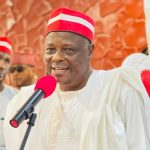


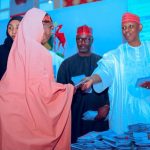

The Minister of Agriculture and Food Security, Abubakar Kyari, says Nigeria spends over $10 billion annually importing food items such as wheat, rice, sugar, fish and tomato paste.
Kyari disclosed this on Tuesday in Lagos at the First Bank of Nigeria Ltd. 2025 Agric and Export Expo.
Represented by his Special Adviser, Mr Ibrahim Alkali, Kyari expressed concern over the country’s ballooning food import bill and called for urgent action to boost agricultural financing to increase local production and exports.
“Agriculture already contributes 35 per cent of our Gross Domestic Product and employs 35 per cent of our workforce. We sit on 85 million hectares of arable land with a youth population of over 70 per cent under the age of 30. Yet Nigeria accounts for less than 0.5 per cent of global agro-exports,” he said.
“Currently, the nation earns less than \$400 million from agro exports. To build a non-oil export economy, we must rethink how we finance agriculture,” he added.
Reiterating President Bola Tinubu’s commitment to attaining food sovereignty, the minister stressed the need to scale up investments across the agricultural value chain.
“President Tinubu has made it clear that food sovereignty is the goal. Nigeria must not only feed itself but do so on its own terms, free from excessive dependency on imports,” Kyari stated.
“Sovereignty means ensuring that no Nigerian goes hungry because of shocks in global food supply chains. It means empowering every community to stand on the strength of our land, our people, and our productivity.
“Boosting domestic production and supporting exports are not separate agendas — they are two sides of the same coin. We have the land, the labour, and the markets. What we lack is the system of financing, value addition, and infrastructure that can turn potential into prosperity,” he added.
According to him, the transformation Nigeria seeks requires a shift “from dependence on oil rigs to resilience in food and export earnings; from raw commodity exports to value-added agribusiness; from fragmented farmer credit to structured financial systems that attract significant capital; and from stereotypes to active youth participation in agriculture.”
He advocated adoption of innovative funding models to strengthen food security.
“Nigeria can do better if we begin to think critically and improve mechanisms such as revenue sharing, agricultural financing with performance triggers, factoring forward contracts, Pay-as-Harvest schemes, and more.
“These are not abstract theories. They are proven models working successfully in real economies,” the minister said.
NAN
