
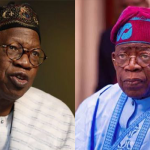
President Bola Tinubu on Friday presented a N58.18 trillion 2026 Federal Budget to the National Assembly, with N5.41 trillion allocated to defence and security, representing about 9.3 per cent of the total expenditure.
Presenting the budget, tagged “Budget of Consolidation, Renewed Resilience and Shared Prosperity,” Tinubu said the allocation underscored the central role of security in driving investment and economic growth.
According to the president, the 2026 budget reflects the administration’s resolve to consolidate macroeconomic stability, enhance competitiveness and ensure that growth outcomes are broadly shared among Nigerians.
He said the budget was anchored on realism, prudence and growth orientation, with key aggregates showing expected total revenue of N34.33 trillion and total expenditure of N58.18 trillion.
Tinubu said recurrent (non-debt) expenditure was projected at N15.25 trillion, while capital expenditure was put at N26.08 trillion.
The president said the budget deficit stood at N23.85 trillion, equivalent to 4.28 per cent of Gross Domestic Product (GDP), noting that this was consistent with the administration’s fiscal framework.
“These figures are not merely accounting entries; they reflect our national priorities. We remain firmly committed to fiscal sustainability, debt transparency and value-for-money spending,” he said.
Tinubu explained that the 2026–2028 Medium-Term Expenditure Framework and Fiscal Strategy Paper provided the parameters for the budget.
He said the projections were based on a conservative crude oil benchmark of 64.85 dollars per barrel, crude oil production of 1.84 million barrels per day and an exchange rate of N1,400 to the dollar for the 2026 fiscal year.
The president said the budget also prioritised healthcare, with about six per cent of allocations, in addition to infrastructure development, agricultural reforms and measures to attract private investment to enhance food security and economic resilience.
He added that priority areas in agriculture included input financing, mechanisation, irrigation, storage facilities and agro-value chains aimed at reducing post-harvest losses and improving farmers’ incomes.
“These priorities are interconnected. Without security, investment cannot thrive. Without educated and healthy citizens, productivity will not rise. Without infrastructure, jobs and enterprise will not scale,” Tinubu said.
He said the 2026 budget was designed as a coherent programme of national renewal, building on previous reforms to deliver consolidation, renewed resilience and shared prosperity.
The president noted that the proposed 2026 budget represented a 5.8 per cent increase over the N54.99 trillion 2025 appropriation signed into law.
