


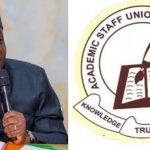


The Federal Government and the Academic Staff Union of Universities (ASUU) have signed a comprehensive agreement aimed at improving lecturers’ welfare, ensuring industrial harmony and ending recurrent disruptions in federal universities.
The agreement, tagged the 2025 Federal Government–ASUU Agreement, was unveiled on Wednesday in Abuja by the Minister of Education, Dr. Tunji Alausa.
Alausa described the pact as a historic turning point capable of restoring trust, dignity and confidence in Nigeria’s university system after years of strikes and instability.
“This is more than the unveiling of a document. It symbolises renewed trust, restored confidence and a decisive turning point in the history of Nigeria’s tertiary education system,” the minister said.
He credited President Bola Ahmed Tinubu with what he described as an unprecedented intervention in resolving a long-standing crisis that had crippled universities, disrupted academic calendars and affected millions of students.
“For the first time in our history, a sitting President confronted this challenge head-on and gave it the leadership attention it truly deserved,” Alausa said.
According to him, the administration deliberately chose “dialogue over discord, reform over delay, and resolution over rhetoric.”
Alausa said a major highlight of the agreement was a 40 per cent upward review of the emoluments of university academic staff, approved by the National Salaries, Incomes and Wages Commission (NSIWC).
He added that the new pay structure would take effect from Jan. 1, 2026.
Under the revised framework, he explained that academic remuneration would comprise the Consolidated University Academic Staff Salary (CONUASS) and an enhanced Consolidated Academic Tools Allowance (CATA).
The minister said the strengthened CATA was designed to support journal publications, conference participation, internet access, professional memberships and book development, with a view to boosting global competitiveness and curbing brain drain.
The agreement, he noted, also restructured nine Earned Academic Allowances, which are now clearly defined, transparently earned and directly linked to duties performed.
“These include postgraduate supervision, fieldwork, clinical responsibilities, examinations and academic leadership roles,” he said.
Alausa further disclosed that, for the first time in Nigeria’s university system, the Federal Government had approved a Professorial Cadre Allowance for full-time Professors and Readers.
According to him, the allowance recognises the academic, administrative and research responsibilities of senior academics.
Under the scheme, he said Professors would receive N1.74 million annually, amounting to N140,000 monthly, while Readers would earn N840,000 annually or N70,000 monthly.
The minister explained that the allowance was intended to enhance research coordination, academic documentation and administrative efficiency, enabling senior academics to devote more time to teaching, mentorship and innovation.
“This intervention is not cosmetic. It is structural, practical and transformative,” he said.
Alausa commended President Tinubu’s “uncommon, courageous and people-centred leadership,” adding that sustained engagement, fiscal realism and mutual respect made it possible to resolve a crisis that had lasted over two decades.
He assured Nigerians of the Federal Government’s commitment to the full implementation of the agreement under the Renewed Hope Agenda.
According to him, the government will sustain engagement and reforms in the education sector.
The minister also praised members of both negotiating teams, led by Alhaji Yayale Ahmed for the Federal Government and Prof. Pius Piwuna for ASUU.
He equally commended the immediate past ASUU leadership under Prof. Emmanuel Osodeke for laying the foundation for the breakthrough.
“History will remember today not just as an unveiling ceremony,” Alausa said, “but as the day Nigeria chose dialogue, transparency and strong presidential commitment as the pathway to resolving long-standing governance challenges.”
He expressed optimism that the agreement would usher in a new era of stability and excellence in Nigerian universities, restore predictability to academic calendars and renew hope for students and parents nationwide.
