


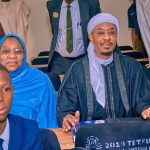

Former Deputy Governor of Kano State, Professor Hafiz Abubakar, has said Islamic principles of justice, equity and inclusiveness offer a viable pathway to addressing Nigeria’s deepening divisions and challenges of peaceful coexistence.
Abubakar stated this on Tuesday in Kano while declaring open the third International Islamic Conference organised by the Department of Islamic Studies, Northwest University, in collaboration with the International Institute of Islamic Thought (IIIT).
He said Nigeria’s struggle with diversity and nationhood mirrors experiences from early Islamic history, noting that Islam provides tested frameworks for managing plural societies.
“Our Prophet in Medina came and met a diverse society. He organised it in such a manner that everybody lived in peace, feeling well-treated and included. That is what Nigeria is looking forward to,” Abubakar said.
The former deputy governor, who is also the Chairman of the Governing Council of Northwest University, stressed that Islam’s emphasis on justice and fairness could help Nigeria overcome divisions rooted in religion and ethnicity.
According to him, scholarly discussions must go beyond theory and translate into practical solutions that promote unity.
“We must see Islam in its true perspective, not the concocted perspective,” he said, adding that wider participation in Islamic scholarship would enable it to contribute directly to national healing and reform.
He expressed optimism that applying Islamic values to governance and social relations would “deepen our collective understanding, strengthen peaceful coexistence, and reaffirm the role of Islamic scholarship in addressing the pressing challenges of our time.”
Speaking earlier, Head of the Department of Islamic Studies, Dr. Nura Abubakar Gwadabe, said the conference was designed to provide a platform for scholars and researchers to propose practical solutions to Nigeria’s challenges.
He explained that experts from diverse fields were invited to deliberate on issues such as insecurity, economic hardship and nationalism.
Dr. Gwadabe attributed many of Nigeria’s current crises, including ethnic conflicts and farmer-herder clashes, to intolerance and the erosion of historical values of coexistence.
“Had it been we know our history, we know ourselves, we know what the religion has planned for us, we would not have this kind of difference between ourselves,” he said.
He added that the conference aims to remind Nigerians of Islam’s unifying principles and promote peaceful relations among Muslims and adherents of other faiths.
Also speaking, Director of the Bayero University Centre for Gender Studies (CGS), Safiya Ahmad Nuhu, said the conference was timely, particularly in promoting pluralism and engagement with emerging global issues.
“One of the key takeaways is the need to engage in Islamic scholarship in emerging issues like climate change, artificial intelligence, information technology and global health, so as to lend research-based voices to these issues,” she said.
