
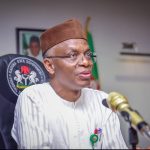


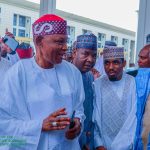

Former Kaduna State Governor, Nasir El-Rufai, has attributed Nigeria’s persistent economic underperformance not to a lack of talent, capital, or ideas, but to the misallocation of the country’s most capable minds.
In a statement shared on Facebook on Wednesday, El-Rufai said, “Nigeria’s growth problem is not primarily a shortage of talent, capital, or ideas. It is a problem of where our best talent goes—and why.”
He explained that highly skilled Nigerians often gravitate towards activities offering the highest immediate returns, particularly where small differences in ability generate large rewards.
“People do not wake up intending to harm their country. They respond rationally to incentives,” he added, noting that Nigeria’s current system disproportionately rewards rent-seeking over productive enterprise.
El-Rufai cited data showing that GDP growth stood at about 4.1 percent in 2024, while GDP per capita remained around US$1,084, placing Nigeria among lower-income economies. Informal employment accounts for nearly 93 percent of the labour force, and the country’s tax-to-GDP ratio is only 8.2 percent.
“These numbers are not abstract,” he said. “They describe an economy where scale is risky, visibility attracts predation, and long-term investment struggles to compete with short-term access.”
He highlighted the consequences of diverting talent from production, warning that it slows technological progress, reduces the quality of entrepreneurship, and lowers the economy’s long-term growth potential.
El-Rufai also cited systemic barriers such as unreliable power supply, delayed port operations, and limited formal employment, which hinder the scaling of productive businesses.
However, he noted signs of potential in sectors like non-oil exports, including cocoa, fertiliser, cashew, and processed agricultural goods. “When incentives align—even partially—Nigerian firms can compete and scale,” he said.
He proposed reforms to make productive activity more rewarding than rent-seeking, including reducing discretionary government power, digitising and making rules predictable, enforcing property rights, and facilitating business growth.
Concluding, El-Rufai stressed: “Nigeria’s future does not hinge on slogans, nor on personalities. It hinges on who wins in our economy. If the system rewards producers over extractors, growth will follow—rapidly and durably. Nigeria does not lack talent. Nigeria must reallocate it.”
El-Rufai made the statement on the same day he attended the Federal High Court in Kaduna for the resumed hearing of his bail application.
He arrived at the court premises around 9:00 a.m. and alighted at 9:05 a.m., drawing the attention of security operatives and a few observers.
Proceedings on Tuesday were stalled after his defence filed a motion seeking the recusal of the presiding judge, Justice Rilwan M. Aikawa, over alleged bias and a pending petition.
