


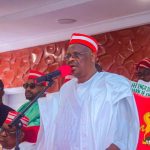


Human rights lawyer Femi Falana (SAN) and the Aare Ona Kakanfo of Yorubaland, Gani Adams, have warned that Nigeria could end up with only one presidential candidate in the 2027 elections if the judiciary continues to interfere in political party affairs.
The warning came during the fifth Comrade Yinka Odumakin Memorial Lecture at Airport Hotel, Ikeja, Lagos, attended by notable figures including NLC President Joe Ajaero, Sahara Reporters publisher Omoyele Sowore, and Senior Advocate Olumide Fusika.
Falana criticized recent court rulings, noting that conflicting judgments were destabilizing political parties. Referencing INEC’s decision to no longer recognize factions of the African Democratic Congress (ADC) led by David Mark and Rafiu Bala, he said, “Through the manipulation of Nigerian courts and senior lawyers, you may have only one candidate contesting the presidential election in this country. If that happens, Nigeria may not even need to spend money on a presidential election.”
He urged civil society, labour unions, and activists to organize to defend democracy, warning that uncoordinated protests could lead to chaos. “We must stop agonising and start organising in the interest of our people and democracy,” he added.
Adams echoed the concern, saying, “We are moving towards a one-party system. Those in power are using the judiciary to suppress the will of the people. We may end up having only one presidential candidate in Nigeria if care is not taken.”
He cautioned Nigerians not to remain silent, regardless of their ethnic group’s political dominance.
Falana also addressed restructuring, arguing that most powers remain controlled by the political elite, making Nigeria more a unitary state than a true federation.
“In 1963, there were about 45 items on the Exclusive List, but today we have about 68 items. Practically everything is controlled by Abuja. What we have now is more of a unitary system than a federal system,” he said.
He criticized states for failing to utilize powers in areas like electricity, railways, and prisons, and warned that state police could be misused to suppress opponents.
Fusika (SAN) cautioned that insecurity could spark a national crisis, while Richard Akinola decried an “incestuous relationship” between the executive and judiciary.
Ajaero supported restructuring and local control of resources, stressing that any revolution must be organized. Sowore described current circumstances under the Bola Tinubu administration as “revolutionary times” that could enable Nigerians to drive change.
The lecture, titled “Can Nigeria’s Democracy Work Without Restructuring?” concluded with a call for activists and civil society groups to honor the late Comrade Yinka Odumakin by committing to justice, democracy, and good governance.
