



Public schools in Kano State are grappling with a severe shortage of teachers and classroom facilities, with one teacher attending to as many as 105 pupils in pre-primary and primary schools, according to findings from the 2024/2025 Annual School Census (ASC).
The report, obtained by Daily Trust, showed that the pupil-teacher ratio in public pre-primary and primary schools stands at 105:1, far above both national and international standards.
According to the report, junior secondary schools recorded a teacher-student ratio of 50:1, while senior secondary schools posted 37:1.
The United Nations Educational, Scientific and Cultural Organisation (UNESCO) recommends a pupil-teacher ratio of 25:1 at the primary school level.
Similarly, Nigeria’s National Policy on Education prescribes a ratio of 1:25 for pre-primary schools, 1:35 for primary schools and 1:40 for secondary schools.
Despite being released in December 2025, the Kano State Ministry of Education confirmed that the census remains the latest official assessment of the state’s education sector.
The report attributed the pressure on schools to a surge in enrolment, revealing that 5,690,634 learners were enrolled in public schools during the period under review.
The figure comprises 683,773 pupils in pre-primary schools, 4,034,744 in primary schools, 509,314 students in junior secondary schools, 412,518 in senior secondary schools, 31,236 learners in science and technical schools, and 19,049 participants in adult and non-formal education centres.
The report noted that the growing enrolment has placed enormous pressure on teachers, classrooms and other educational facilities, raising concerns over the quality of teaching and learning across public schools.
It, however, stated that the state government blamed the situation on years of neglect by previous administrations, adding that efforts have been ongoing to reverse the trend since the declaration of a state of emergency in education three years ago.
According to officials, the government has continued to invest heavily in the education sector to bridge the shortage of teachers and improve infrastructure, although the rising enrolment remains a major challenge.
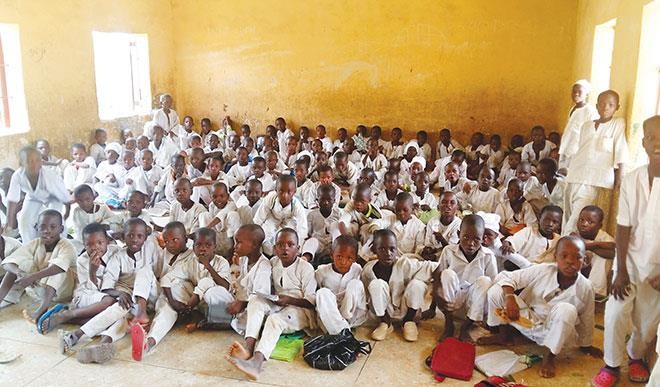
The census also revealed that classrooms in Kano public schools are heavily overcrowded.
According to the report, an average of 145 pupils share a classroom in public pre-primary and primary schools, while the classroom ratio stands at 78:1 in junior secondary schools and 69:1 in senior secondary schools.
The report indicated that one toilet serves an average of 343 pupils in public pre-primary and primary schools, while the ratios stand at 122:1 in junior secondary schools and 73:1 in senior secondary schools.
The census covered 7,331 public pre-primary and primary schools, 1,451 junior secondary schools, 800 senior secondary schools, 49 science and technical schools, and 63 adult and non-formal learning centres across the state.
Despite the infrastructure challenges, the report highlighted improvements in school participation, particularly among girls.
It stated that girls accounted for 52 per cent of enrolment in pre-primary and primary schools, 56 per cent in junior secondary schools and 54 per cent in senior secondary schools.
At the primary level alone, enrolment stood at 4,034,744 pupils, including 2,095,761 girls, while junior secondary schools recorded 509,314 students, of whom 284,708 were female.
The report further disclosed that Kano’s public education system is currently supported by 45,007 teachers across different levels, with the majority deployed to pre-primary and primary schools.
The Annual School Census is used by government and development partners to assess enrolment trends, infrastructure needs and resource gaps in the education sector.
Reacting to the findings, the State Commissioner for Education, Ali Haruna Makoda, acknowledged the challenges but said the government had already initiated several interventions to improve the sector.
Speaking during the recent visit of the Minister of State for Education, Professor Suwaiba Sa’id Ahmad, to inspect AGILE projects in the state, Makoda disclosed that contracts worth over N24 billion had been awarded for the construction of 49 new schools, while plans were underway to renovate 300 schools across the state’s 484 wards.
The commissioner recalled that the government declared a state of emergency in the education sector in 2023 due to years of neglect and decaying infrastructure.
He said education had consistently received the highest budgetary allocation in the state, with 29.75 per cent in 2024, 31.5 per cent in 2025 and 30 per cent in 2026.
“Wherever you step in, you will definitely see our project,” Makoda said.
He added that more than 2,500 classrooms had been renovated, while over 18,000 teachers had been recruited to bridge staffing gaps and address imbalances across schools.
Makoda further stated that under the state’s new teacher deployment policy, newly recruited teachers are expected to serve in their native communities to ensure rural schools are adequately staffed.