
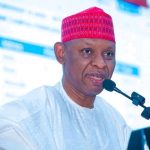
The Kano State Government has dismissed claims that Governor Abba Kabir Yusuf cannot secure a second term without the backing of Senator Rabiu Musa Kwankwaso, describing such views as misleading and a poor interpretation of Kano’s political history.
In a statement issued on Monday, the Commissioner for Information and Internal Affairs, Comrade Ibrahim Abdullahi Waiya, said Kano’s political culture has never been permanently controlled by godfathers, insisting that power ultimately resides with the electorate.
Waiya was reacting to comments attributed to a chieftain of the New Nigeria Peoples Party (NNPP), Engr. Buba Galadima, who reportedly suggested that Governor Yusuf’s political survival depended solely on Kwankwaso.
“With due respect to Engr. Buba Galadima, an elder statesman and long-standing actor in Nigeria’s political arena, his assertion that Governor Abba Kabir Yusuf cannot secure a second term without Senator Rabiu Musa Kwankwaso is analytically weak, misleading, and dismissive of Kano State’s deeply rooted political culture,” the commissioner said.
While acknowledging Kwankwaso’s influence, Waiya argued that it was wrong to assume that Kano’s political future could be permanently tied to one individual.
“There is no dispute that Senator Dr. Rabiu Musa Kwankwaso is a political heavyweight. However, to suggest that Kano’s political future is permanently contingent on the shadow of a single individual, regardless of stature, is to misread both history and the democratic behaviour of the people in the state,” he stated.
Waiya also recalled that Galadima once benefited from what he described as Governor Yusuf’s inclusive leadership, noting that he was appointed Chairman of the Governing Council of Kano State Polytechnic despite not being an indigene of the state.
“That gesture was driven by trust and an expectation of value addition. Regrettably, the tenure yielded little or no measurable impact, as no notable reform initiative or developmental programme was meaningfully contributed,” the statement said.
He stressed that leadership should be judged by results rather than public commentary, adding, “Leadership is not validated by loud commentary but by tangible outcomes.”
The commissioner maintained that Kano voters have historically demonstrated independence in political decision-making, citing the emergence of former Governor Ibrahim Shekarau in 2003 and Kwankwaso’s own return in 2011 as examples of leadership earned through performance.
“Kano voters, time and again, have demonstrated an independent streak that resists permanent political ownership,” Waiya said.
On Governor Yusuf’s mandate, the commissioner said the governor was elected by the people and defended his victory through due process.
“Governor Abba Kabir Yusuf did not assume office by political charity. He was elected by the people of Kano, across party lines and political interests, defended his mandate through institutional processes, and assumed power with popular legitimacy,” he said.
According to Waiya, the governor has since focused on education, institutional reforms and rebuilding public trust, adding that political authority in Kano is consolidated through service delivery, not inherited influence.
He further explained that Yusuf’s political decision was influenced by internal crises within the NNPP.
“The NNPP has been confronted with persistent internal conflicts and crises arising from leadership disagreements and ongoing legal processes, many of which are presently before the courts for judicial determination,” the statement said.
Waiya added that divisions within the party had created uncertainty at both state and national levels but stressed that the governor’s decision was taken in good faith and in the interest of Kano State.
“This decision is taken in good faith, without any ill will, and with a continued commitment to peace, unity, and the progress of Kano State,” he said.
The commissioner concluded by urging residents to trust in divine will, noting that Kano politics has always rewarded performance over proximity to power.
