

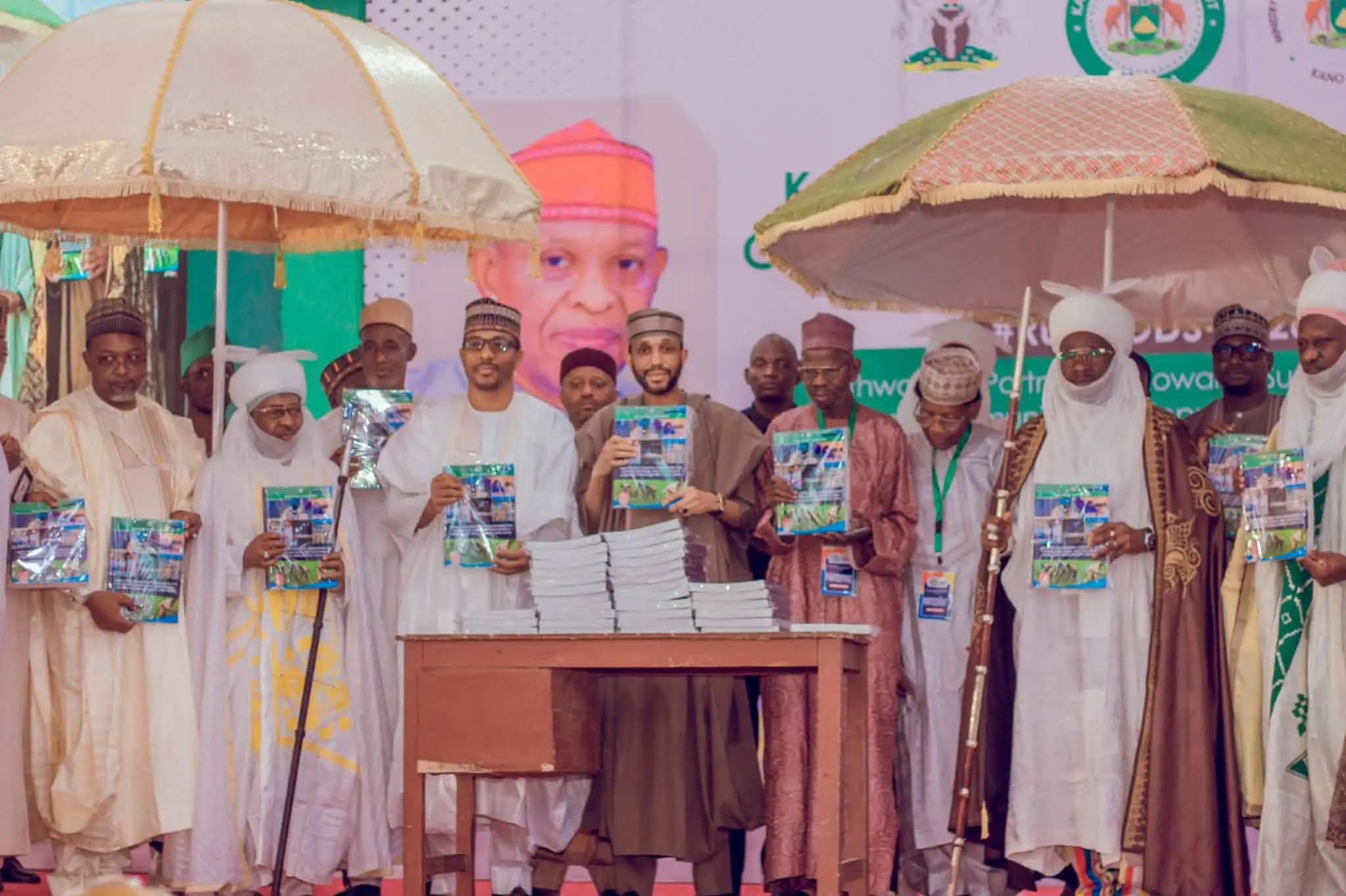
The Kano State Government on Tuesday unveiled a five-year Strategic Framework for Integrated Rural and Sustainable Community Development aimed at reducing rural poverty, improving infrastructure and strengthening service delivery across the state.
Governor Abba Kabir-Yusuf unveiled the framework at the Kano State Rural and Sustainable Community Development Summit (RUSCOD-2026), held under the theme, “Pathway for Partnership Towards Sustainable Rural and Community Development in Kano State.”
The governor, represented by the Deputy Governor, Murtala Sule-Garo, said the framework reflects his administration’s commitment to integrating rural communities into the state’s development agenda.
He said sustainable rural development remained critical to achieving inclusive economic growth, social progress and environmental sustainability.
According to him, Kano’s economic growth depends largely on the productivity of rural communities, where agriculture, trade and small-scale enterprises provide the main source of livelihoods.
Kabir-Yusuf acknowledged that despite government investments in infrastructure, healthcare, education, agriculture, rural electrification and water supply, many rural communities still face development challenges.
He identified inadequate infrastructure, limited access to quality healthcare and education, unemployment, climate-related challenges, insecurity, and poor water and sanitation facilities as major obstacles to rural development.
“These challenges call for thoughtful planning, prudent investment and stronger collaboration among government, development partners, financial institutions, the private sector, civil society organisations, traditional institutions, women and youth groups as well as the communities themselves.
“No single institution possesses all the resources or expertise required to address these challenges alone,” he said.
The governor reaffirmed his administration’s commitment to creating an enabling environment that would encourage partnerships capable of accelerating sustainable rural and community development across the state.
Earlier, the Commissioner for Rural and Community Development, Abdulkadir Abdulsalam, described the document as the state’s first integrated rural development plan covering all the 44 local government areas and 484 wards.
He said the framework was developed using data collected from more than 300 communities and 9,000 households across 36 rural local government areas.
According to him, the evidence-based framework will guide policy formulation, budget planning and project implementation between 2026 and 2030.
Abdulsalam said the plan targets a 40 per cent reduction in rural poverty by 2030 through interventions in healthcare, education, agriculture, infrastructure, water, sanitation and hygiene, rural roads, social protection, security, governance and climate resilience.
He added that implementation would be carried out in phases, beginning with institutional strengthening and baseline studies in 2026, followed by quick-impact projects in 2027, infrastructure expansion and the consolidation of community ownership by 2030.
The commissioner said funding for the framework would come from the state and local governments, federal interventions, development partners, philanthropic organisations and community contributions.
Also speaking, the Emir of Kano, Muhammadu Sanusi II, described the summit as a timely initiative.
Represented by the Emir of Karaye, Muhammad Mahraz-Karaye, Sanusi urged the government and stakeholders to prioritise agricultural transformation, skills acquisition and healthcare.
“Rural infrastructure, security and effective implementation of development policies to improve the living conditions of rural dwellers,” he said.
The summit was attended by the Emirs of Kano, Karaye, Rano and Gaya, representatives of the Deputy Senate President, development partners and other stakeholders.