


Scientists and biosafety experts have reaffirmed that genetically modified organisms (GMOs) approved for cultivation and consumption in Nigeria undergo years of rigorous scientific testing and regulatory scrutiny before receiving approval, amid persistent public concerns over their safety. They say every approved GMO crop is subjected to extensive scientific evaluation and regulatory oversight before it reaches farmers or consumers.

Despite these assurances, the term Genetically Modified Organism continues to evoke uncertainty and suspicion among many Nigerians. From heated social media debates to radio phone-in programmes and community discussions, questions about the safety of genetically modified crops remain widespread. As Nigeria increasingly turns to agricultural biotechnology to strengthen food security and build climate resilience, scientists are working to separate evidence from misinformation and explain the safeguards behind every approved GMO.
According to the experts interviewed, every approved GMO crop passes through a lengthy scientific and regulatory process involving specialists from multiple disciplines, extensive laboratory and field testing, and strict oversight designed to protect human health, animal welfare and the environment.
One of the biggest misconceptions, they say, is that decisions on GMO safety are left solely to crop scientists. In reality, the evaluation process draws on expertise from medicine, toxicology, nutrition, environmental science, food safety and biodiversity.
Maimuna Abdulmalik, Professor of Plant Physiology at the Institute for Agricultural Research (IAR), Ahmadu Bello University, where she oversees regulatory approvals and compliance, said the assessment of genetically improved crops involves a broad network of experts.
“The approval process requires detailed scientific data that must be reviewed by experts from various fields,” she said. “The focus is not only on crop performance but also on food safety, allergenicity, livestock feed safety and environmental impact.”
She described the multidisciplinary review as a comprehensive safety net that ensures approved products meet both national and international standards before reaching farmers or consumers.
At its simplest, a GMO is an organism whose genetic material has been modified through modern biotechnology to introduce beneficial traits that do not exist in the conventional variety.
Professor Mohammed Ishyaku, a veteran plant breeder at Ahmadu Bello University’s Institute for Agricultural Research, said the technology enables scientists to develop crops that can better withstand some of agriculture’s biggest challenges.
“These modifications may help crops resist pests, tolerate drought, mature earlier or produce higher yields,” he said. “The goal is to improve crop performance while maintaining the essential characteristics that farmers and consumers value.”
Dr. Yakubu Doguwa, another researcher at the institute, explained that genetic modification builds on scientists’ understanding of genes, the units of heredity that determine an organism’s characteristics.
“Through biotechnology, scientists can identify desirable genes and use them to develop improved crop varieties with specific traits,” he said during a radio programme.
One of Nigeria’s most prominent GMO products is TELA maize, developed to withstand insect attacks while tolerating drought and other environmental stresses.
According to Professor Ishyaku, insect damage remains one of the leading causes of yield losses among maize farmers.
“Farmers growing conventional maize often lose a significant portion of their harvest to insect pests. TELA maize is designed to better withstand these attacks,” he said.
The varieties currently available in Nigeria, SAMMAZ 72T, SAMMAZ 73T, SAMMAZ 74T and SAMMAZ 75T, were developed through a collaboration between the Institute for Agricultural Research, Ahmadu Bello University, Zaria, and the African Agricultural Technology Foundation (AATF). Researchers say the varieties offer higher productivity, stronger pest resistance and better tolerance to environmental stress than many conventional maize varieties.
Addressing Safety Concerns
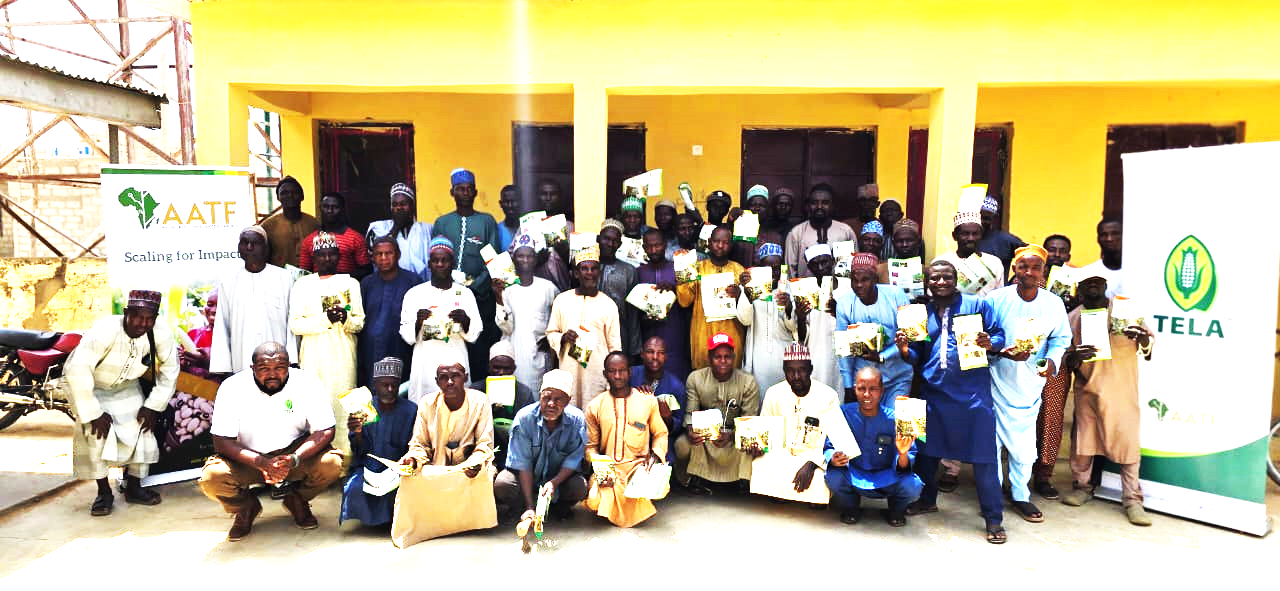
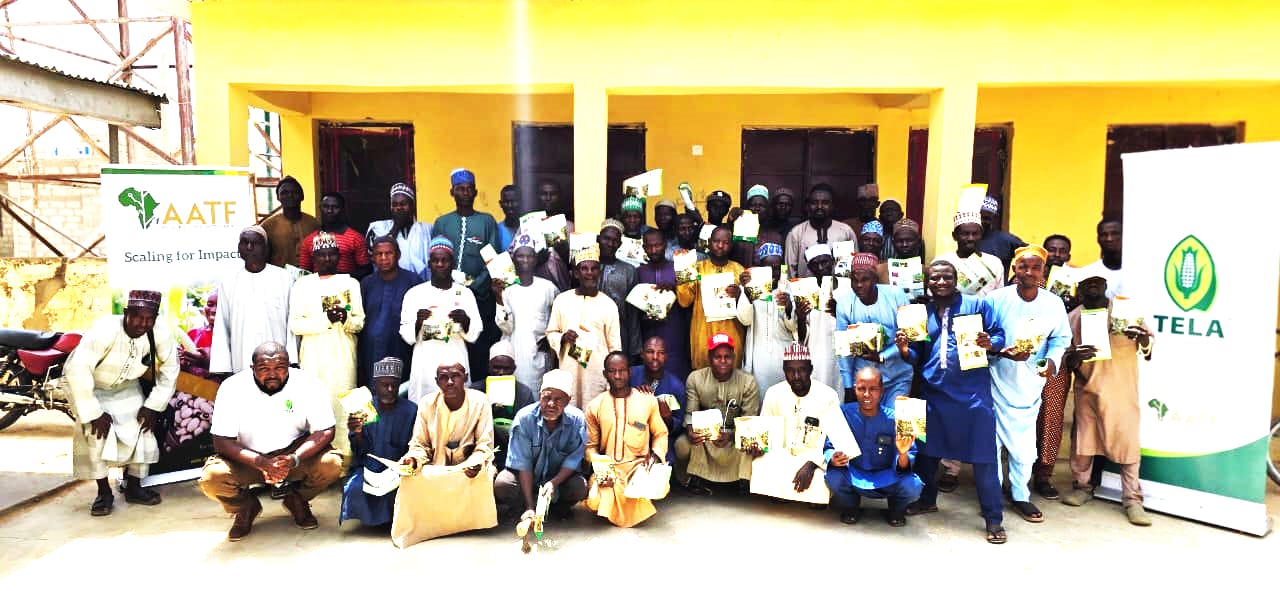
Farmers and community members in Kano State displaying information leaflets and packs of TELA maize distributed to them for trial after sensitization exercise
Perhaps the most common question surrounding GMOs is whether they are safe for people and livestock.
Researchers interviewed for this story gave a consistent answer.
“Yes, TELA maize is safe for both humans and animals. Apart from its improved traits, it is nutritionally similar to conventional maize,” Professor Ishyaku said.
Dr. Doguwa echoed the same position, noting that approved GMO crops undergo extensive scientific evaluation before commercial release.
“In Nigeria, GMO crops are assessed by relevant regulatory authorities before commercialization. The available evidence indicates that approved GMO crops are safe for human consumption, animal feed and environmental use,” he said.
Scientists point to decades of international research showing that approved GMO crops are as safe and nutritious as conventional varieties.
In Nigeria, biotechnology products are regulated by the National Biosafety Management Agency (NBMA), which serves as the country’s biosafety gatekeeper. Every GMO application undergoes rigorous scientific review before approval, in line with national regulations and international agreements, including the Cartagena Protocol on Biosafety.
For Professor Abdulmalik, the strength of the system lies in its reliance on scientific evidence.
“Safety decisions are based on evidence, not opinions,” she said. “The assessments rely on data generated through scientific research and reviewed by qualified experts.”
Public concerns, however, often extend beyond science to cultural and religious beliefs.
Dr. Doguwa noted that biotechnology is already embedded in everyday life, although many people may not realise it.
“Certain medicines, including some insulin products used by diabetic patients, are produced using biotechnology. When evaluating GMO products, people should focus on scientific evidence and regulatory assessments,” he said.
Responding to questions during a recent radio programme about possible health risks, he added: “Based on available scientific evidence and regulatory reviews, there is currently no confirmed evidence linking approved GMO crops to specific diseases or health problems in humans or animals.”
Beyond laboratories and regulatory agencies, researchers say the technology is increasingly being judged by its performance on farmers’ fields.
According to Dr. Doguwa, farmers who have adopted TELA maize have reported lower losses from insect damage and improved harvests.
“The response has been encouraging,” he said, adding that demand for the variety has continued to grow as more farmers see its productivity and economic benefits.
As Nigeria searches for solutions to food insecurity, climate stress and rising production costs, biotechnology is becoming an increasingly important part of the agricultural conversation.
For the scientists involved in developing and regulating GMOs, the message is clear: approved genetically modified crops are the product of years of research, rigorous testing, multidisciplinary review and evidence-based regulation. While public debate is likely to continue, they argue that discussions about GMOs should be guided by scientific evidence rather than fear.