


By Hadiza Yahaya Abubakar
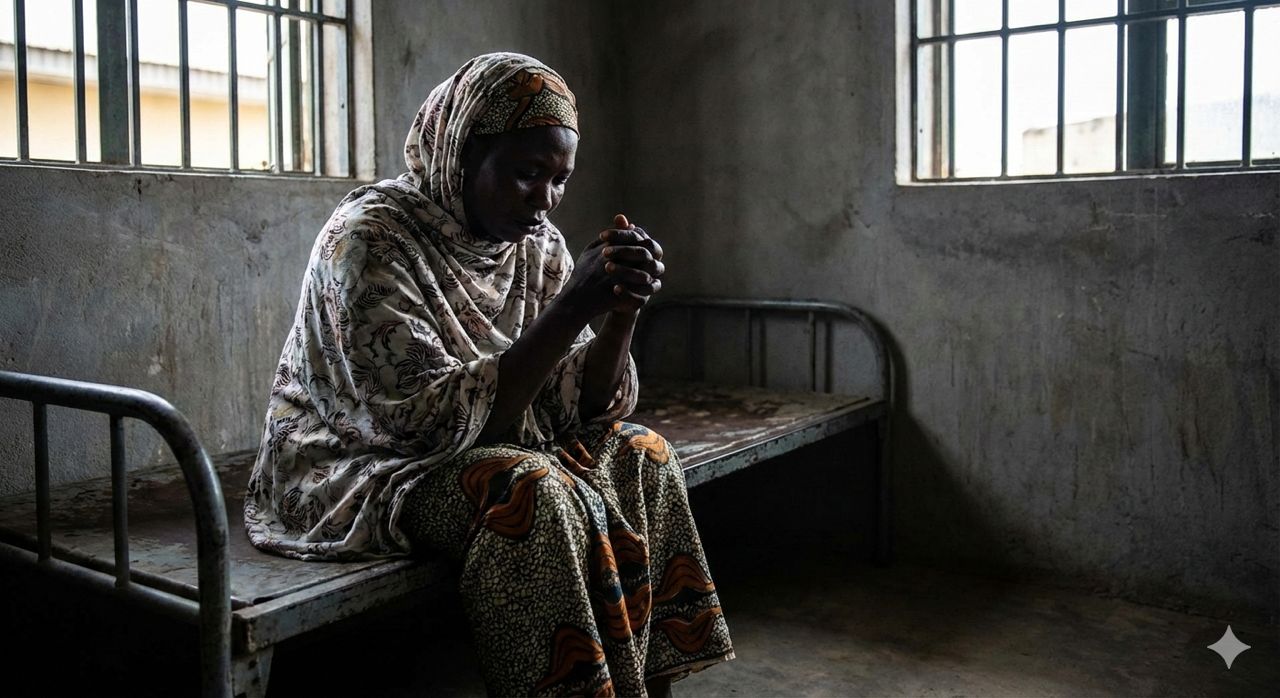
Bilkisu still struggles to find words for what prison did to her.
“What I went through is something I would never wish on anyone, not even my enemy,” she says quietly.
In her family, no one had ever been arrested before. She had never stepped into a police station. Yet one accusation, unsupported by evidence, took away seven years and eight months of her life.
She was accused of murder.
“I detest that word,” Bilkisu says. “I am even scared of killing an ant, talk more of a human being.”
An Arrest Without Evidence
Bilkisu recalls how a man arrived at her home and insisted she should be reported to the police because she was “closest” to a woman who had died. Her husband refused. The man reported her himself.
She went with the police believing it was a routine investigation. At the police headquarters in Bompai, officers took her statement, examined her phone records, and even involved a telecom company. Nothing linked her to the crime.
The police cleared her.
But the deceased woman’s family insisted the matter must go to court.
Bilkisu says she was taken to court on Miller Road, never saw a judge, and was sent straight to prison.
“That was the day we saw hell,” she says.
Years of Adjournments
She was first held at Nomansland Prison, then repeatedly moved between prison and court. Hearings were adjourned for months. Sometimes, she says, nothing happened in court at all.
“Before, I used to count how many times I went to court. Later, I lost count,” she says.
Her business collapsed. Her savings disappeared. Her life froze.
After more than seven years in custody, witnesses testified in her favour. Police confirmed again that no evidence linked her to the murder. The court finally declared her innocent.
“I just accepted my fate and kept praying,” Bilkisu says. “God answered my prayers.”
She now appeals to the government to look closely at people in custody.
“A lot of them are innocent,” she says.
One Year Lost Over a Business Dispute
Bala’s experience followed a different path but led to the same destination: prison without judgment.
A businessman, Bala says he supplied goods to someone who failed to pay him. When pressure mounted from his own supplier, the dispute escalated and he was arrested.
“I refused to plead guilty because I did nothing wrong,” he says.
Bala spent one year in custody awaiting judgment. He describes overcrowded cells, hunger, and lack of medical care.
“If you don’t have family bringing you food, you can die of hunger in prison,” he says.
He estimates more than 2,000 inmates were held where food, mats, and beds were insufficient. According to him, even sick inmates received the same medication regardless of their condition.
Eventually, after speaking out in court, Bala was acquitted.
“The right that was mostly violated was my right to bail,” he says. “There was no evidence against me.”
Awaiting Trial, Awaiting Justice
The Nigerian Correctional Service (NCoS) Kano State Command acknowledges that awaiting-trial inmates form the majority of the prison population.
According to the Command’s Public Relations Officer, Musbahu Lawal Kofar Nassarawa, about 60 per cent of inmates in Kano custodial centres are awaiting trial, while 40 per cent are convicted.
The PRO says the Service continues to engage stakeholders in the justice sector, including the police, Ministry of Justice, and judiciary, to address prolonged detention.
He confirms that “congestion remains a major challenge. Kurmawa Custodial Centre, built for 1,330 inmates, currently holds over 1,550. A new 3,000-capacity facility in Janguza was constructed to ease the pressure.”
He adds that inmates are entitled to basic rights, including feeding, visits, medical care, recreation, and religious activities.
A Structural Human Rights Failure
Legal Practitioner, Auwal Muhammad Salihu, say cases like Bilkisu’s and Bala’s point to deeper systemic problems.
“Making a person spend seven years in custody only to later find them innocent means something is fundamentally wrong,” he explains.
According to the lawyer, Nigerian laws already guarantee the right to fair hearing, presumption of innocence, and trial within a reasonable time under Section 36 of the Constitution.
“From a human rights perspective, the problem is not the absence of laws,” he says. “It is the failure to implement them.”
He explains that bail should be the rule, while detention should be the exception — especially when there is no flight risk or threat to witnesses.
“When these safeguards are ignored, the justice system itself becomes the punishment,” he says.
Lives Paused, Freedom Delayed
For Bilkisu, freedom came too late to undo the damage.
“Everything I had finished,” she says.
For Bala, one year behind bars meant lost income, disrupted family life, and stigma.
Their stories raise urgent human-rights questions:
How many innocent people are still behind bars awaiting trial?
And how long should freedom wait for justice to act?
The names used in this report have been changed to protect the identities of the individuals.
This story was supported by HumanAngle Foundation, under the SCOJA Fellowship