

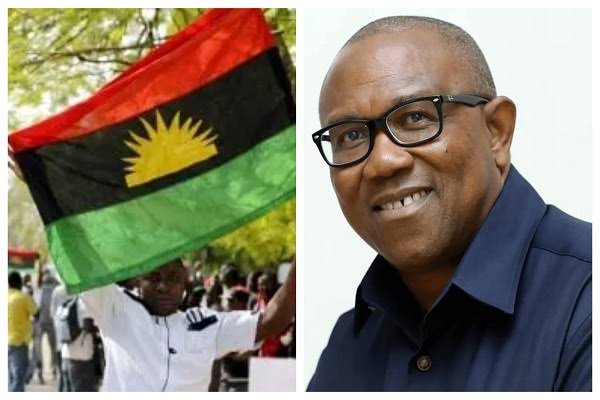
The Northern Youth Assembly (Majalisar Matasan Arewa) has said that the failure of the presidential candidate of the Nigeria Democratic Congress (NDC), Peter Obi, to retract his 2017 comments on the Indigenous People of Biafra (IPOB) could pose a major challenge to his 2027 presidential ambition in Northern Nigeria.
In a statement signed by its Secretary General, Hafiz Garba, PhD, on Tuesday, the group argued that Obi’s comments questioning the designation of IPOB as a terrorist organisation remain one of the most controversial aspects of his political record.
According to the group, Obi’s position on IPOB has “never been retracted, corrected, or replaced by anything that could be reasonably interpreted as a changed position” since it was first made in 2017.
Garba recalled that Obi, while speaking on Channels Television’s Politics Today programme on October 1, 2017, had said: “The only thing I disagree with is naming IPOB terrorist. They are not terrorists.”
The Northern Youth Assembly noted that the statement has remained in public discourse because it was never formally withdrawn by the former Anambra State governor.
“The most dangerous statements are the ones that are never retracted, never formally revisited, and never replaced by a position that more accurately reflects the gravity of what was originally said,” the statement said.
The group maintained that the issue resurfaced during the 2023 presidential election and generated significant debate across Northern Nigeria.
“The political significance of the statement did not end in 2017. It resurfaced with devastating effect ahead of the 2023 presidential election, generating widespread outrage across Northern Nigeria and deepening the already substantial trust deficit that Obi faced,” Garba stated.
The assembly further argued that Northern political leaders had consistently described Boko Haram and bandits as terrorists and expected similar clarity regarding IPOB.
“Peter Obi had not extended the same moral clarity to IPOB, and the question of why he had not was one that his campaign never satisfactorily answered,” the statement added.
The group also criticised Obi’s July 2023 statement on insecurity, claiming it failed to directly address concerns about IPOB.
According to Garba, the statement “was not a retraction of his 2017 position” but rather “a careful and deliberately constructed restatement of it in language that was marginally more diplomatic but substantively identical.”
The Northern Youth Assembly further argued that developments in the South-East in recent years had increased the political significance of Obi’s earlier comments.
“The political context of 2027 makes this unresolved liability significantly more dangerous for Obi’s northern ambitions than it was in 2023,” the group said.
It added that the humanitarian and economic consequences of sit-at-home orders and insecurity in the region had heightened public scrutiny of political leaders’ positions on the issue.
The group insisted that before the 2027 election, Northern voters would seek a clear answer from Obi on whether he considers IPOB a terrorist organisation.
“Does Peter Obi consider IPOB a terrorist organisation, yes or no?” the assembly asked.
According to the statement, “until he answers that question with the directness, the specificity, and the moral clarity that the question demands, every rally he holds in the North and every promise he makes to northern communities will be shadowed by the nine-year-old statement that sits in the public record.”
The assembly concluded that the matter goes beyond campaign strategy and touches on public confidence in leadership.
“Peter Obi’s IPOB problem is not a campaign management challenge. It is a character and credibility question,” Garba said.
“And in the North, where the cost of ambiguity on terrorism has been measured in blood, it may ultimately prove to be the question that his 2027 presidential ambition cannot survive.”