

The Kano State Accountability Forum on Education (K-SAFE) has called on the Kano State Government to urgently implement measures to reduce the number of out-of-school children in the state.
The forum made the call in a statement signed by its Co-Chair, Auwalu Halilu, following the completion and presentation of the Kano State Out-of-School Children (OOSC) Household Survey Report 2026.
 K-SAFE commended the state government, Ministry of Education and development partners for conducting the survey across the 44 Local Government Areas, describing it as an important milestone in addressing the state’s education challenges.
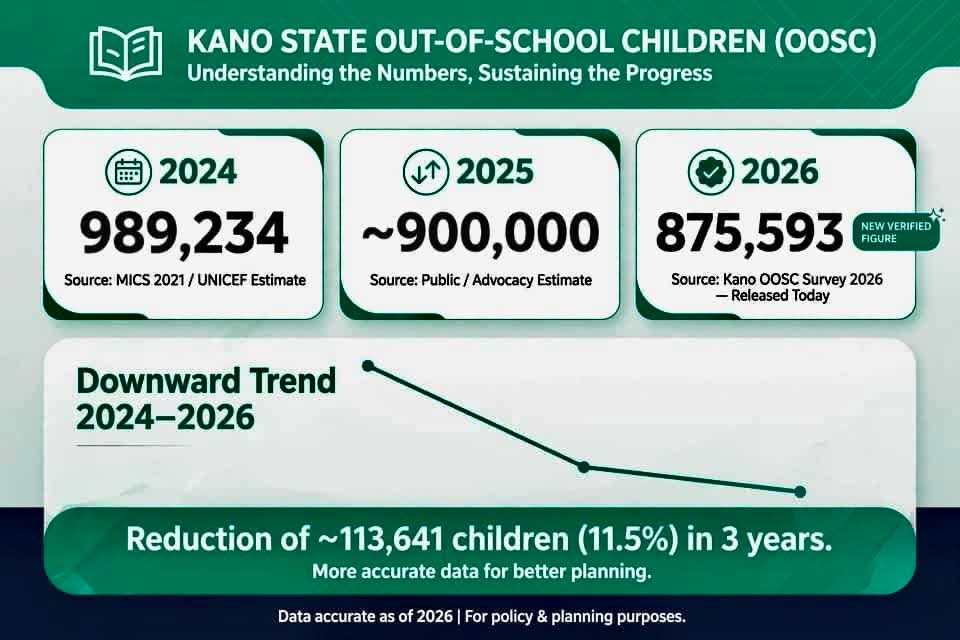
The survey estimates that 13.34 per cent of children aged between five and 18 are out of school, representing about 875,593 children across the state.
According to K-SAFE, the report provides credible and geographically specific data that should guide education planning, resource allocation, implementation, monitoring and accountability.
It, however, urged the government to ensure that the survey does not end as a report but becomes a roadmap for coordinated action.
“The findings demand urgent and sustained action,” the forum said, noting that the survey identified poverty, financial constraints, school-related issues, family and cultural circumstances, child-related factors, distance and other structural challenges as major barriers to education.
K-SAFE said the finding that 99.6 per cent of caregivers consider children’s education important or very important was particularly encouraging.
It argued that the high level of parental support showed that the out-of-school challenge was not simply a result of lack of interest in education, but was largely linked to accessibility, affordability, quality, retention and the ability of the education system to respond to vulnerable children and families.
The forum urged the government to prioritise communities and LGAs with the highest burden of out-of-school children and ensure that resources are allocated based on identified needs.
It also called for the strengthening of the Kano State Universal Basic Education Board to expand access, improve school infrastructure, provide adequate teachers and learning materials, strengthen monitoring and improve the quality of basic education.
K-SAFE further advocated increased support for the Kano State Agency for Mass Education to expand non-formal and alternative education programmes, literacy centres, second-chance education and vocational learning opportunities.
It also called for stronger integration of foundational literacy and numeracy, basic education, life skills and vocational competencies into Qur’anic, Tsangaya and Islamiyya education.
The forum urged relevant technical and vocational education institutions to provide skills-development pathways for older out-of-school children, adolescents and young people, including training in entrepreneurship, digital literacy, financial literacy and employability skills.
It said measures to tackle poverty, strengthen social protection, support livelihoods, improve child protection and provide school feeding where feasible should complement education interventions.
K-SAFE also called for the establishment of a strong monitoring and accountability framework to track progress from the 2026 survey baseline.
It urged the Ministry of Education, SUBEB, SAME, Qur’anic and Tsangaya education authorities, local governments, traditional institutions, civil society organisations and development partners to work together in addressing the problem.
The forum said every child identified by the survey represented “more than a statistic” and urged stakeholders to translate the findings into measurable action.
“The data are now available. The barriers are clearer. The priority must now be ACTION,” K-SAFE said.
The forum expressed optimism that coordinated and adequately funded interventions could substantially reduce the number of out-of-school children and expand access to quality basic education, alternative learning opportunities and relevant skills across Kano State.