

Kano’s political history has produced families whose names have remained in circulation long after individual elections and administrations have come and gone.
For some, the connection began in local government. For others, it was business, community activities or an early involvement in party politics that opened the way. Over time, some of these families have had members serving as councillors, local government chairmen, commissioners, lawmakers and political appointees.
The Sule Garo family is one of them.
Across several decades, members of the family have appeared at different levels of Kano’s political structure. Some have served in local government, some in the Kano State Government and others in the National Assembly. Some have also remained active in business.
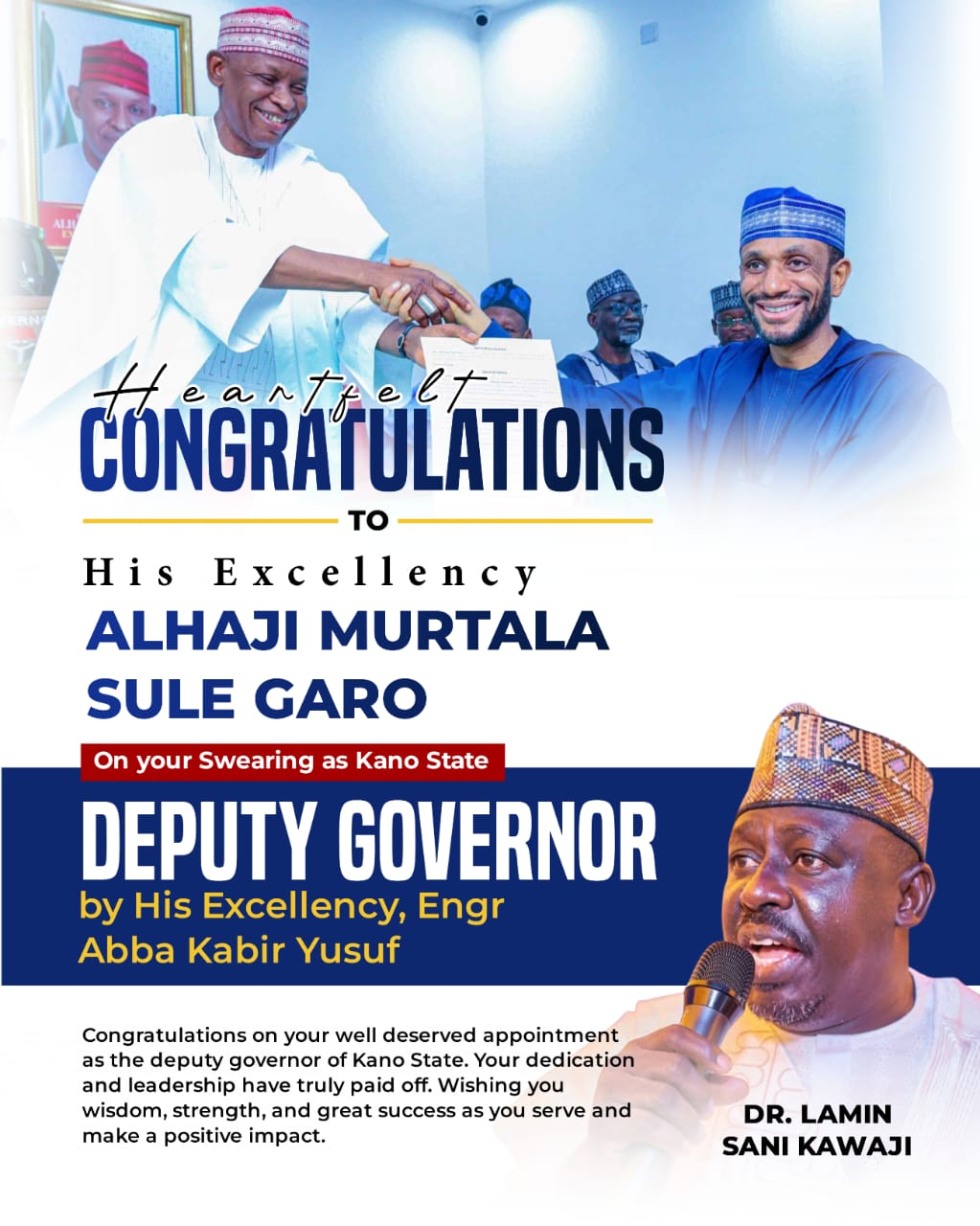
The latest and perhaps most significant chapter came in April 2026, when Murtala Sule Garo was confirmed as Deputy Governor of Kano State.
That development brought the family’s long association with politics to the second-highest political office in the state.
But the story did not begin there.
It goes back to the late Alhaji Sule Galadima Garo, a businessman and philanthropist whose children would later take different routes through business and public life.
The man behind the name
Sule Galadima Garo died in 2007 after establishing himself as a businessman in Kano.
His public profile was largely built around business, religion and community activities. He was also a father to a large family, some of whose members would later become known in Kano’s political and business circles.
There was no single political path mapped out for his children.
Some went into business. Others entered politics through local government. Some combined business with political activities.
It was through this gradual movement that the Sule Garo name began appearing more frequently in Kano’s political landscape.
The pattern is not unusual in Nigerian politics.
Political families often grow over time. A father or an older relative establishes relationships in business, community life or government. Younger members subsequently enter public affairs, sometimes building on those existing relationships and sometimes creating political identities of their own.
In Kano, where local politics has historically been an important route into state and federal politics, the local government system has provided an entry point for many politicians.
The Sule Garos followed that route.
From Garo to the local council
Lawan Sule Garo, the first son of the family, was among the early members to enter politics.
He became a councillor representing Garo in the former Gwarzo Local Government.
His political career was at the grassroots, where councillors were directly involved in the administration and politics of their communities.
After his political career, Lawan returned to business.
His experience reflected a pattern that would become familiar among members of the family: politics and business were not necessarily separate pursuits.
While some members concentrated on public office, others continued to build commercial interests.
The business side of the family
Tijjani Sule Garo became associated with GB Tannery Nigeria Limited, a company with a long history in the leather business.
GB Tannery’s business history stretches back more than a century. It is regarded as a third-generation family enterprise involved in processing goat and sheep skins into finished and crust leather for export.
The company represents an important part of the family’s story because the political activities of the Sule Garos developed alongside a business tradition.
The family’s involvement in business also meant that not every member who became politically active abandoned commercial interests.
For some, the two worlds existed side by side.
Aminu and the move to Abuja
The family’s political reach expanded beyond Kano’s local government structure with Aminu Sule Garo.
Aminu entered national politics at a time when Nigeria was passing through successive political transitions.
He first served in the House of Representatives between 1992 and 1993 under the National Republican Convention, NRC.
He returned to the House between 1995 and 1996 under the United Nigeria Congress Party, UNCP.
His political career later took him to the Senate.
In April 2007, Aminu Sule Garo was elected to represent Kano North in the Senate.
The victory, however, did not last.
His election was annulled in December 2007 following a legal challenge over his qualifications.
The episode nevertheless marked an important point in the family’s political history. A member of the Sule Garo family had moved from grassroots politics into the National Assembly and contested one of the most politically significant senatorial districts in Kano.
Kabo and the grassroots
While Aminu was operating at the national level, another branch of the family was building a political base at the local level.
Rabi’u Sule Garo served two terms as chairman of Kabo Local Government.
Local government chairmanship has traditionally been an important political position in Kano, giving its occupant direct contact with communities and local political structures.
For Rabi’u, the local government years became an important part of his political career.
After leaving office, he moved further into business and became involved in the oil business.
His career again demonstrated the movement between politics and commerce that has characterised the wider family.
Nasiru Garo and state politics
Nasiru Sule Garo took another route through the political system.
He represented the Gwarzo/Kabo Federal Constituency in the House of Representatives.
His political activities later brought him into the Kano State Government.
He served as Commissioner for Environment and Climate Change under the administration of former Governor Abdullahi Umar Ganduje and was subsequently moved to the Ministry of Special Duties.
The movement from the National Assembly to the state executive was another indication of the range of political positions occupied by members of the family.
In August 2026, Nasiru returned to electoral politics when he emerged as the candidate of the Nigeria Democratic Congress, NDC, for the Kano North Senatorial District ahead of the 2027 general election.
His candidacy means the Garo name will once again appear on the ballot for a major federal political contest in Kano.
Murtala Garo’s political climb
If the earlier members of the family established the political route, Murtala Sule Garo took it further.
His political career began at the grassroots.
He served as a Special Adviser in local government administration before becoming chairman of Kabo Local Government Area.
From there, he became chairman of the Kano State chapter of the Association of Local Governments of Nigeria, ALGON.
The position gave him wider exposure to local government politics and administration across the state.
He subsequently entered the Kano State Executive Council during the administration of Abdullahi Umar Ganduje.
As Commissioner for Local Government and Chieftaincy Affairs, he operated at the centre of relations between the state government and local councils.
The portfolio also brought him into matters involving traditional institutions and local administration.
His political fortunes later shifted with the changing political landscape in Kano.
In the 2023 governorship election, Murtala Garo was the deputy governorship candidate of the All Progressives Congress, APC.
The election ended with the APC losing the governorship to the New Nigeria Peoples Party, NNPP, whose candidate, Abba Kabir Yusuf, became governor.
Three years later, however, the political equation changed again.
After his nomination by Governor Abba Kabir Yusuf, the Kano State House of Assembly confirmed Murtala Garo as Deputy Governor on April 27, 2026.
For the Sule Garo family, the appointment represented a new point in its political history.
Murtala had moved from councillor-level politics and local government administration to the state executive, and eventually to the office of Deputy Governor.
Beyond the big offices
The political footprint of the family is wider than the names that have occupied the most prominent offices.
Sadisu Sule Garo served as a vice chairman of a local government.
Mustapha Sule Garo served as a Supervisory Councillor in Kabo Local Government, while Musbahu Sule Garo also served as a Supervisory Councillor before becoming involved in business.
Farouk Sule Garo, PhD, has combined party politics and government work.
He served as Senior Special Assistant to former Governor Abdullahi Umar Ganduje on Monitoring and Evaluation and contested the Gwarzo/Kabo Federal Constituency seat in the House of Representatives on two occasions.
He currently serves as a Senior Legislative Aide to the member representing the constituency.
Bello Sule Garo has been involved in party organisation, particularly youth politics.
He served as Youth Leader of the New Nigeria Peoples Party in the Kano North Senatorial District.
These positions may not carry the national visibility of a Senate seat or deputy governorship, but together they show how different members of the family have occupied positions at various points of Kano’s political structure.
Marriage and political connections
Politics also connects families through marriage, and the Sule Garos are no exception.
Hajiya Salamatu Sule Garo is married to Senator Rabi’u Musa Kwankwaso, a former governor of Kano State and a major figure in the state’s political history.
Another member of the family, Hajiya Rakiya Sule Garo, is married to Lamin Rabi’u Danbappa, a former Director-General of the Kano State Pilgrims Welfare Board.
These relationships have extended the family’s connections beyond its own political activities.
They also illustrate how political and social networks in Kano can overlap, with relationships extending from electoral politics to government administration and community life.
What makes a political family?
The story of the Sule Garos raises a broader question about the place of family networks in Nigerian politics.
Political experience can be passed from one generation to another, but it is rarely a simple matter of inheritance.
A family name may provide recognition. Existing relationships can make it easier for a younger politician to enter political circles. Business connections and community relationships may also help create networks.
But none of these automatically guarantees an election victory.
Political parties change. Alliances shift. Voters change their preferences. Politicians who appear dominant in one election can find themselves outside government after another.
The history of the Sule Garos itself reflects these changes.
Members of the family have operated under different political parties and during different administrations. Some have won elections; others have lost contests or had their victories challenged.
Their political careers have therefore been shaped not only by family connections but also by the wider political environment.
A name that has endured
The political history of the Sule Garos is ultimately a story of continuity.
It began with Sule Galadima Garo, whose principal public identity was built around business and community life.
His children later entered different fields. Lawan moved into local government politics. Aminu reached the National Assembly. Rabi’u became a local government chairman. Nasiru combined legislative politics with service in the Kano State Government.
Murtala’s career followed the same broad route but reached a higher office, culminating in his confirmation as Deputy Governor of Kano State in 2026.
Other members have occupied positions in local government, political parties, government offices and legislative support roles.
The family has therefore remained present through several political eras.
But its future political standing, like that of every political family, will depend on more than its history.
The 2027 elections will provide another test.
Nasiru Garo is preparing to contest the Kano North Senate seat under the NDC, while Murtala Garo is already serving as Deputy Governor.
Their positions place the family once again at important points in Kano’s political calculations.
Whether that translates into further electoral success remains a matter for the voters and the political developments ahead.
For now, the Sule Garo name remains one of the family names that have repeatedly surfaced in Kano’s political history from the local council to the National Assembly and, most recently, the office of Deputy Governor.
(c) Kano Times